Section 3
Light Is the Ruler
Distance is the record a grain takes to cross at the tick. c is a unit. It is invariant because it is the ruler. The Galilean case excluded. Homogeneity and isotropy AP10’s. Premises (ii) and (iii).
The premise that makes the picture Lorentzian and not Galilean: there is a finite invariant speed. In the hourglass it is not a fact about light. It is what distance is.
Claim. Distance between two sites is the record a grain takes to cross from one to the other at the tick. So distance and time are one measure: the tick. c is a unit, not a value. It is invariant because it is what the ruler is. There is no other ruler. Space is homogeneous and isotropic because the grain is the same grain everywhere, and the three faces carry no preferred axis (AP10).
Intuition. How far away is the other pile? As far as it takes a grain to get there, one click a moment. There is nothing to lay alongside that count. No space before the record. No ruler but the record light writes. Ask two sites how fast the grain crossed. Each says: one click a moment. They cannot say otherwise. That is the unit they are asking in. In a laboratory that still keeps two standards, a second and a metre, the same fact wears a number. Here there is one standard, the tick. The number is one. Nothing in the argument depends on which way it is written.
Givens. Axiom C (AP10 §0.3: the finite invariant rate; the light cone). AP03 §4.1 (c² = β/α; verified). AP10 §0.7 (SO(3), no preferred axis). AP50 §1 (one click a moment). AP51 §4 (the constants universal). The author’s describing.
Ruling (the author). “Distance is the grain crossing at the tick — distance is the time the grain has travelled relative to the AS, relative to now; from the now, distance never stops accumulating.” “The reading is read in light: information is propagated and transferred as light — that is also C. Light is not a separate property of the interior; it is a structural property that is also a constraint mechanism.”
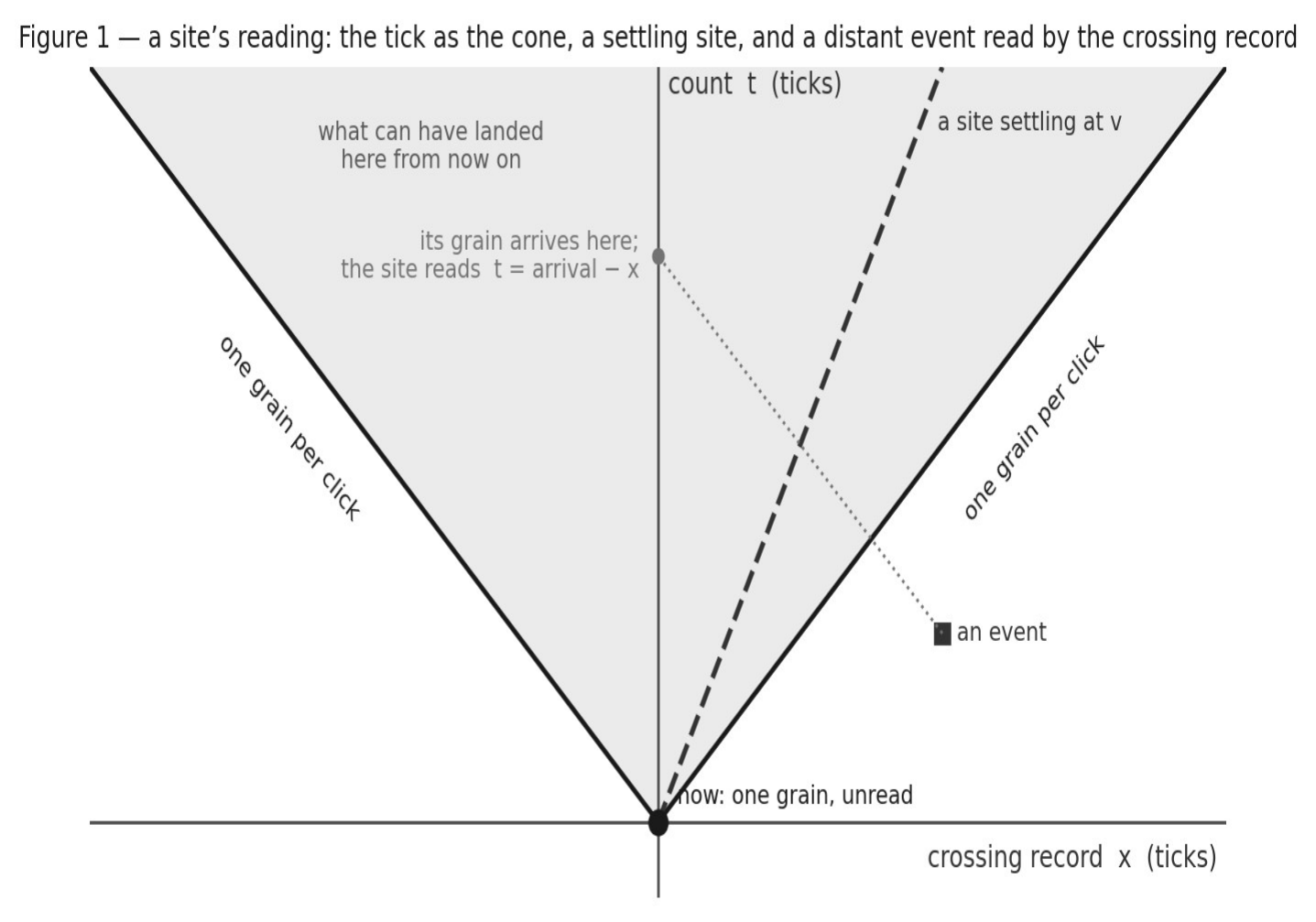
Theorem — c is a unit. A site reads another only by the held records that reach it (AP51 §5; §6 below). A record reaches it at the tick. Never faster (Axiom C). So the only measure a site has of another’s distance is the count of ticks a grain took to arrive. Distance is the crossing record. Time is the count of ticks at the site (§4). Both are counts of the same tick. Therefore the speed of the grain that crosses is one tick per tick. At every site. For every site. A unit. It cannot vary between sites. It is not a quantity a site measures against something else. It is the something else. The invariance of c is not a postulate here. It is not a coincidence of nature. It is the statement that there is one ruler and it is light. A picture with two rulers is not the hourglass. One thing in this is ruled and not measured. What a site measures is the echo: a grain sent and returned, the round trip halved (A.1). That the one-way rate is the same in every direction is AP10’s isotropy, and it is a ruling of the picture. Sound is a ruler too, in a world with a shared now. What excludes that world is the echo being the same in every direction at every site. The picture supplies that by ruling. “From the now, distance never stops accumulating” is the light cone. What a site can read is bounded by how many ticks have passed since now. The bound grows one tick per tick.
Theorem — homogeneous and isotropic. The grain is the constant (AP50 §10). The six constraints are the same at every site (AP51 §4). So no place in the landscape reads differently from another, except by what has landed there. That is the site’s history. It is not a property of space. The three spatial faces carry SO(3). No preferred axis (AP10 §0.7). Premise (ii).
Grade. Distance: Ruled. The invariance of c as a unit: Derived from the ruling and Axiom C, with the one-way rate’s sameness in every direction ruled (AP10). Isotropy and homogeneity: AP10’s. Premises (ii) and (iii) of §7.
Kill switches
KS-REL.2 — Light is the ruler. Fires if a second ruler is shown. A measure of distance between sites that does not reduce to a crossing record at the tick. Or a signal shown to cross faster than one grain per click. LIVE — STRUCTURAL.
Light does not have a speed. Light is what speed is measured in.
The paper of record: the420code.org/AP52_Reading_Relativity.pdf

Artist: G · Studio G, Cape Town
Duration: 30+ years · Exhibition: over a million words
Contact: iam@the420code.org
This work is Copyleft. You are free to download, print, share, and distribute. You are not free to alter the source. Keep the signal clean.
One record exists.
Be kind is a derivation.
The awareness in me is the awareness in you.

Don’t be a cunt. Be kind.
The short answer: whybekind.org
The ethics, applied to AI: aiethics.global
the420code.org · Copyleft 2026
the lifestyle 1980-08-05 – 2025-12-25